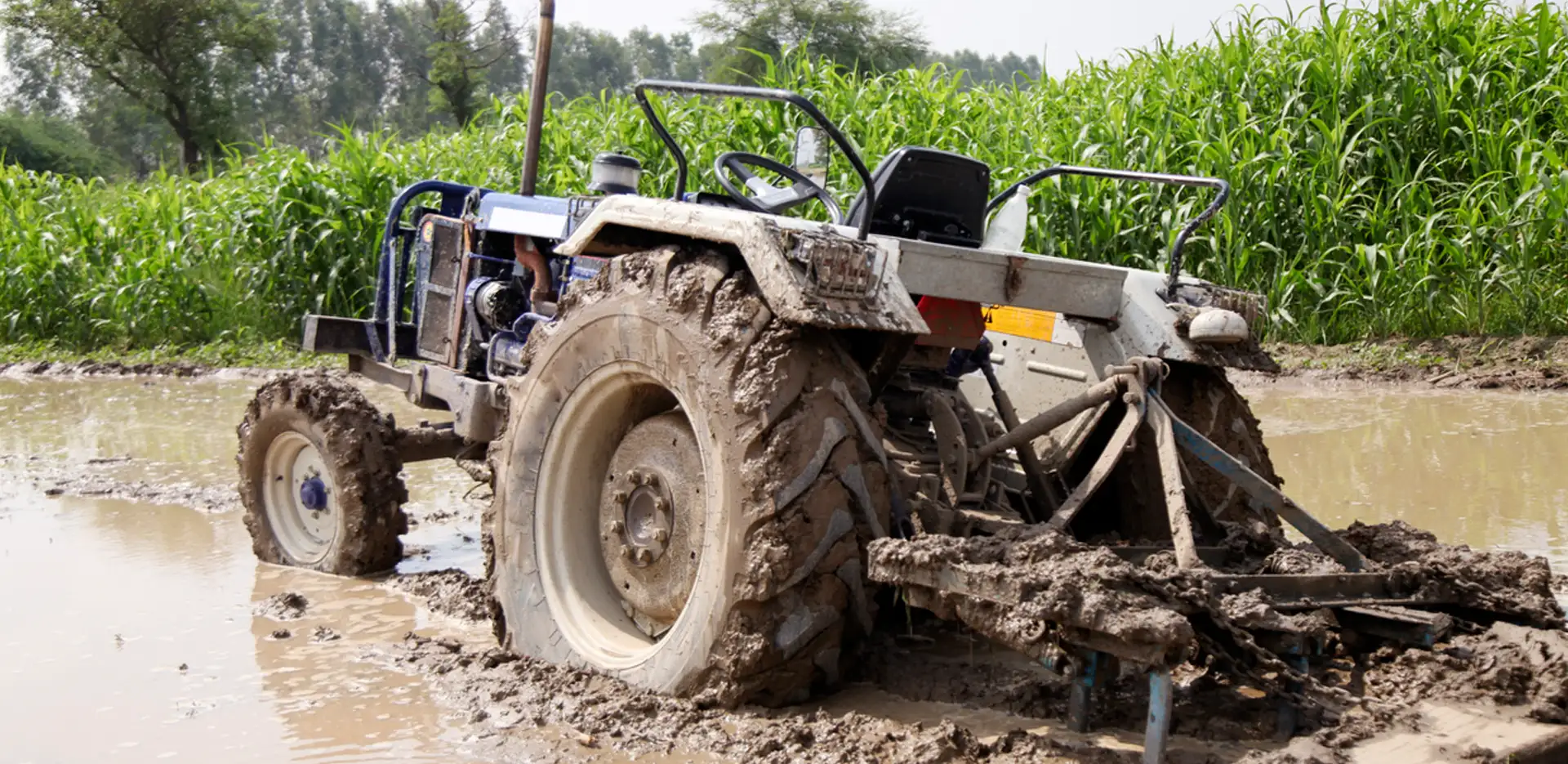
Unfortunately, during these times workers stand a greater chance of getting injured, or worse. Serious, disabling injuries and death shave occurred when a towing device failed. Tractor and truck cabs may not stop the force of the towing device and the recoiling equipment may strike the operator.
But you can reduce the risk by training your workers in safe towing practices when dislodging a stuck vehicle.
Safety precautions and techniques will vary depending, among other things, on:
- Soil conditions
- How deep a vehicle is stuck
- How much the stuck vehicle weighs
- How much the towing vehicle weighs
First step: Breathe easy
Too often the workers and supervisors are in too much of a hurry to extract the vehicle. When people are rushing, they tend to make mistakes, and they can be costly in terms of property damage and injuries.
Second step: Know the weights
Determine how much weight you need to move and how heavy the towing vehicle needs to be. You can get the deadweight in your vehicle owner’s manual. But you need to calculate the total gross weight of what is stuck, including the vehicle, possible trailer, and the payload that you will need to pull.
The size of the towing truck or tractor will depend onthe weight of what’s stuck and how deep it is buried.
A good rule of thumb is that the towing vehicle should weigh at least as much as the stuck vehicle, including any load. If the stuck truck can assist, a towing vehicle of that weight is usually sufficient to get the job done.
If the vehicle is only slightly stuck, then the weight of the pulling equipment should be at least equal to the loaded weight of the stuck vehicle. You’ll need heavier trucks or tractors to extract vehicles that are stuck deeper.
For better traction in the stuck zone, remove or dig out dirt around the sidewalls and in front of the tires.
Ideally, you want to position the towing vehicle on higher ground.
Third step: Clear the gawkers
Extractions and stuck vehicles always attract onlookers. Clear the area of non-essential personnel for everyone’s safety.
Fourth step: Use a proper device
Often people grab the nearest rope, nylon strap, cable or chain they can find, but they need to remember that whatever they use will be put under a significant pulling force or tension.
If this device or a part of the device – such as a hook –breaks, the towing device suddenly becomes a dangerous projectile.
A long towing chain designed to support the towed load is recommended over nylon ropes or cables. Chains will break at their weakest point, so check welds and hooks prior to use.
Use equipment that is rated for the job.
Fifth step: Precautions
You should always do the following (whether the equipment is carrying hazardous materials or not):
- Assess how badly the equipment is stuck and figure out if further damage may result if you continue. If so, call a professional.
- Determine whether the axles are dragging.
- Determine if the vehicle bellied out or is resting on the frame or rear-end housing.
- How much does any cargo weigh? Can it shift if the equipment is pulled?
- Assess the condition of the ground under the pulling vehicle: Is it sand, clay orsnow, and is it hard or soft?
- Take precautions to protect all drivers and by standers from injury and flying debris.
- Determine whether the equipment is leaning to one side.
- Know where power lines are located, to avoid contact with them.
Sixth step: Pre-towing checks/coordination
Initiate the towing process with caution and double-check all attachments to see that they are secure before starting.
If using more than one pulling vehicle, the drivers must coordinate with each other. The drivers and everyone else involved should knowthe plan for extraction.
Each operator should understand the situations that willstop the towing process. If using hand signals to communicate betweenoperators, ensure everyone knows their meaning.
When the towing process begins, apply power smoothlywithout jerking.
Stop and re-evaluate:
- At the slightest sign of danger
- If the tractor front end lifts off the ground
- If there is a slip in attachment of the towing device.