
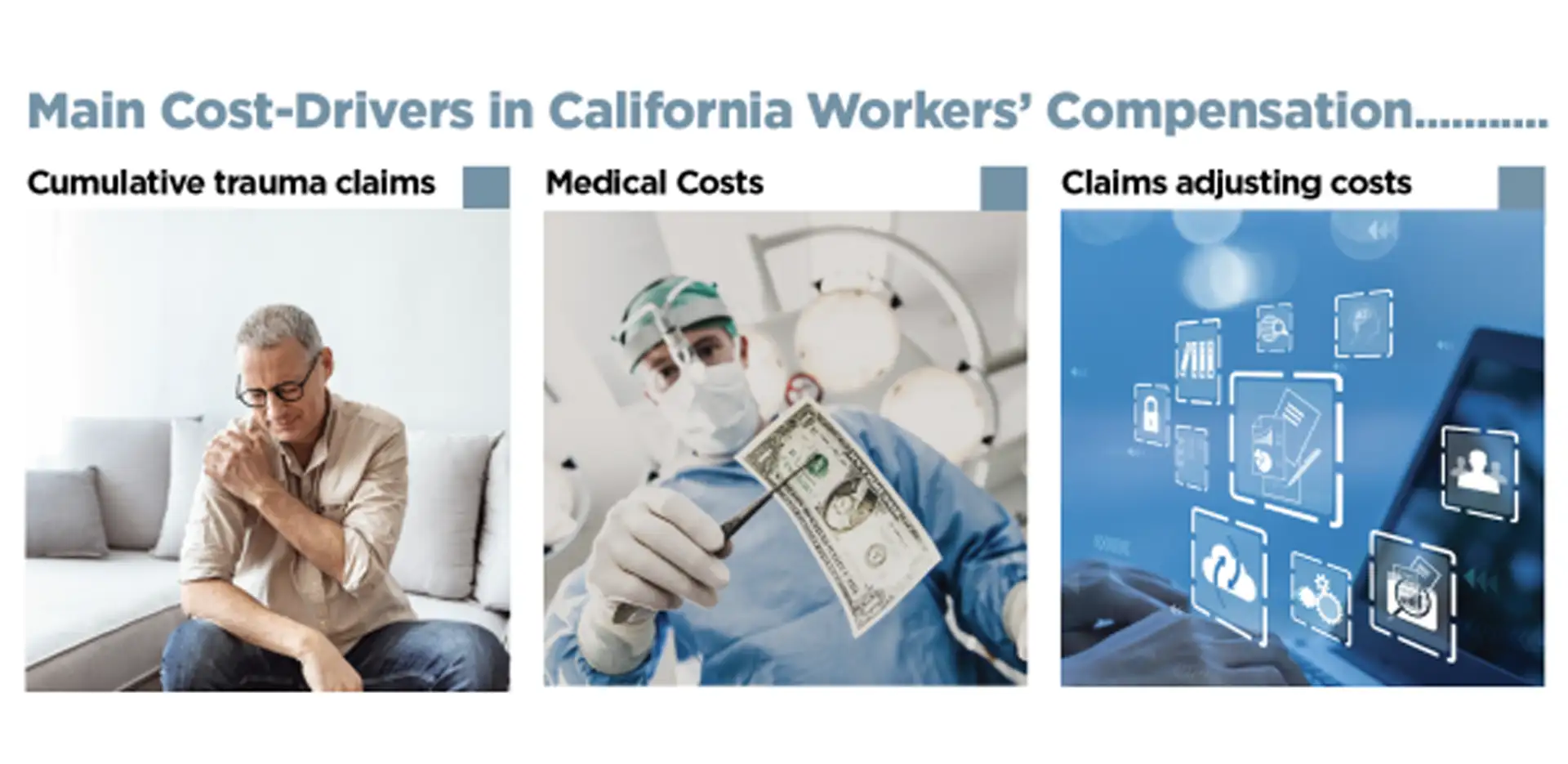
The Workers’ Compensation Insurance Rating Bureau cited an increase in cumulative trauma claims as well as rising medical and administrative costs. The filing, if approved by the California Department of Insurance, would be the second consecutive year that the benchmark rate insurers use to price their policies has increased. Last year the DOI approved an 8.1% hike after WCIRB had recommended an 11.2% increase.
The pure premium rate increase has not resulted in employers with few or no workers’ compensation claims paying higher premiums since insurers only use the pure premium rate as a guidepost when pricing their policies. The pure premium rate remains at historical lows and the market is quite competitive.
The 10.4%recommended increase is an average across all the state’s workers’ compensation class codes, and each class will see a different change.
Here’s a look at the cost drivers:
Cumulative trauma claims
WCIRB estimates that 26.4% of all workers’ comp claims filed in the state in 2025 are for cumulative trauma injuries, compared to 15% in 2021. CT claims are not for sudden injuries, but rather those that develop over time through repetitive motions, such as:
- Carpal tunnel syndrome — Often claimed by office workers, data entry personnel and assembly line workers due to repetitive hand and wrist movements. — Caused by years of lifting, bending, twisting or maintaining poor posture.
- Tendonitis and tendon disorders — Inflammation from repetitive shoulder or arm movements, common in construction, warehouse and food service jobs.
- Shoulder injuries — Rotator cuff tears or bursitis from repetitive overhead lifting.
- Knee problems — Develops from repetitive kneeling, squatting or climbing stairs, frequently seen in plumbers or floor layers.
About three out of every five CT claims are filed after an employee is terminated, according to WCIRB. There is a cottage industry of lawyers who find recently laid-off workers and convince them to file these claims. Adding to the cost:nearly all CT claims are litigated, in most cases from the first notice.
Medical costs
One anomaly in CT claims is that they usually have few medical costs in the first year, which masks the growing issue of rising medical costs for workers’ comp claims. According to WCIRB, average medical costs per claim increased 1.7% between 2021and 2023, but excluding CT claims, that number rises to 3%.
Associated medical-legal costs are up 14% per claim in 2025, while medical equipment and other medical services costs jumped 7% in the same period.
Claims adjusting costs
The high litigation rates for CT claims are seeping into the cost of adjusting claims, according to WCIRB. It projects that insurers’ loss adjustment expense ratio(the cost of adjusting claims) will increase to 37.7% of claims costs, up from35.7% in the Sept. 1, 2025, filing.
The total cost of claims adjusting increased from $12,636 per claim in 2024 to $14,235 in2025 and is expected to rise 5.5% annually between 2026 and 2028 to $16,184.
The takeaway
The Rating Bureau has sent the rate recommendation to the Department of Insurance, which will hold a public hearing in the coming months, after which the insurance commissioner, with input from the public and department actuaries, will either accept the recommendation or order a different rate.
While the workers’ comp market is expected to stay competitive, the rate recommendation could portend moderately increasing rates in the coming years.