
California Insurance Commissioner Ricardo Lara has ordered an average 6.6% increase in the advisory workers’ compensation benchmark rate for policies incepting on or after Sept.1, 2026, marking the second consecutive increase after more than a decade of declining rates.
The rate follows two years of increasing claim and claims adjustment costs, a substantial uptick in cumulative trauma claims and rising medical and administrative costs. The Workers’ Compensation Insurance Rating Bureau (WCRIB) had recommended a 10.4%increase in the average “pure premium” rate.
The pure premium rate is a benchmark insurers use to price policies. It accounts only for the cost of claims and adjusting them, not expenses such as office operations, personnel costs unrelated to claims, marketing or other overhead. Insurers are free to price their policies as they see fit and workers’ compensation rates are still at their lowest level in decades.
The rate increase will bring the average pure premium to $1.65 per $100 of payroll across all class codes. However, insurers are still charging less than that in their full rates, meaning they may not be taking in enough to cover claims costs.
In 2025, collected premiums resulted in an average charged rate of $1.56, down slightly from $1.58 in 2024 and continuing the overall downward trend in market rates that has persisted since the first half of 2015.
Last year, the insurance commissioner approved an 8.7% rate hike, below the 11.2% sought by the Rating Bureau.
The Rating Bureau cited the following to support its rate increase recommendation:
Cumulative trauma claims
WCIRB estimates that 26.4% of all workers’ comp claims filed in the state in 2025 involved cumulative trauma injuries, compared with 15% in 2021. CT claims are not for sudden injuries but rather those that develop over time through repetitive motion, such as:
- Carpal tunnel syndrome — Often claimed by office workers, data entry personnel and assembly line workers due to repetitive hand and wrist movements.
- Chronic back and neck injuries — Caused by years of lifting, bending, twisting, or maintaining poor posture.
- Tendonitis and tendon disorders — Inflammation from repetitive shoulder or arm movements, common in construction, warehouse, and food service jobs.
- Shoulder injuries — Rotator cuff tears or bursitis from repetitive overhead lifting.
- Knee problems — Develops from repetitive kneeling, squatting, or climbing stairs, frequently seen in plumbers or floor layers.
About three in five CT claims are filed after an employee is terminated, according to WCIRB. The high volume of post-termination filings and the fact that most CT claims are litigated contribute to higher claims costs.
Medical costs
One anomaly in CT claims is that they usually incur few medical costs in the first year, which masks the growing issue of rising medical costs for workers’ comp claims. According to WCIRB, average medical costs per claim increased 1.7% between 2021and 2023, but the increase was 3% when CT claims were excluded.
Associated medical-legal costs per claim rose 14% in 2025, while costs for medical equipment and other medical services increased 7% in the same period.
Claims adjusting costs
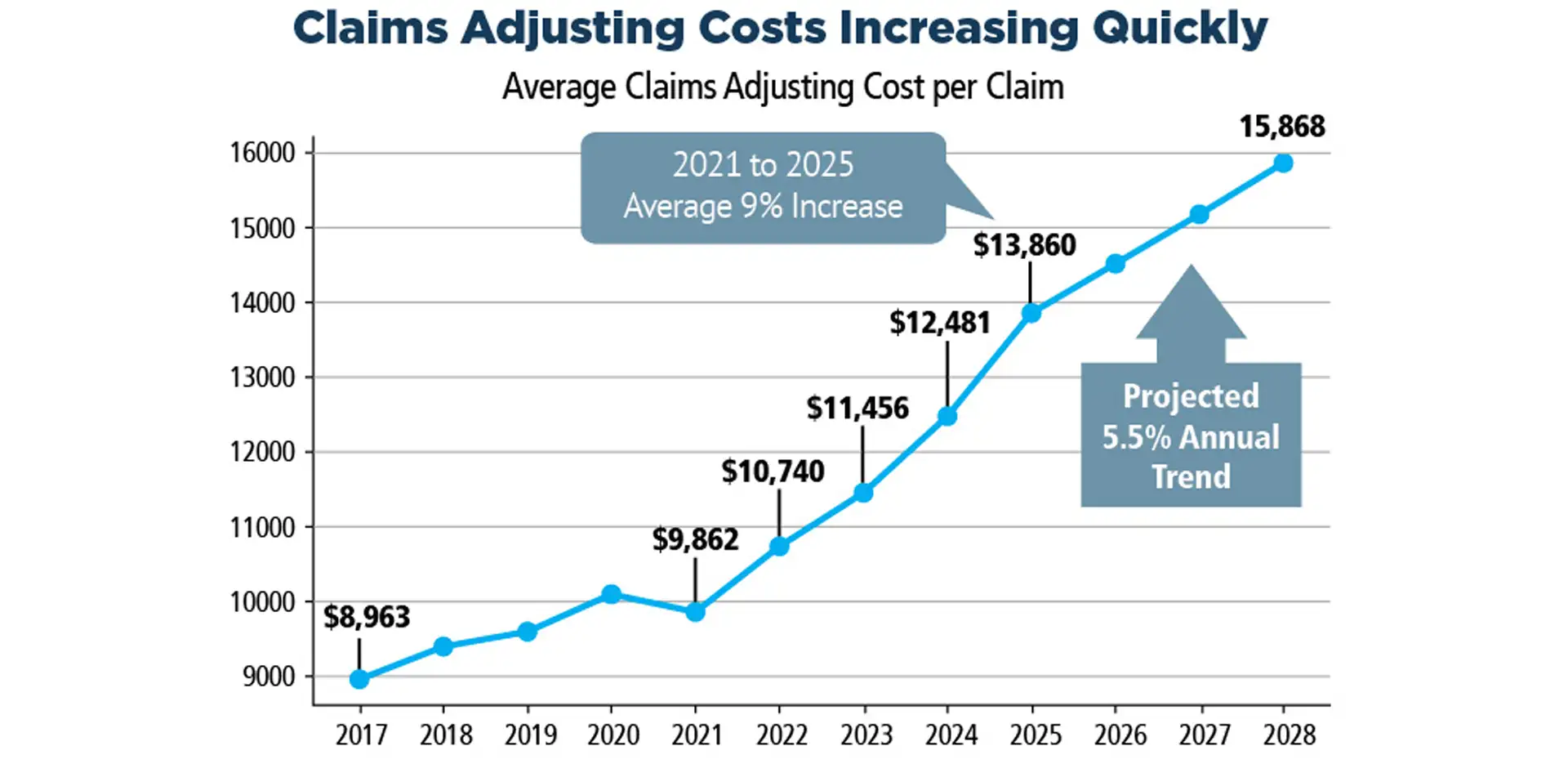
The high litigation rates for CT claims are seeping into the cost of adjusting claims, according to WCIRB. It projects that insurers’ loss adjustment expense ratio (the cost of adjusting claims) will increase to 37.7% of claims costs from 35.7% in the Sept.1, 2025, filing.
Claims adjusting costs are expected to rise 5.5% annually between 2026 and 2028.
The takeaway
While the pure premium rate is rising, employers may see increases or reductions of varying degrees based on several factors, including:
- The employer’s individual claims history,
- The employer’s industry,
- The mix of employees and operations, and
- The employer’s location.
If you have questions about your workers’ comp coverage, please give us a call.